Electricity is movement of charge.
There are no ions in either of these types of solids; therefore ionic conduction is not possible.
Electrons in covalently bonded substances are generally associated with a particular pair of atom or bond (localised) and are not free to move through the substance (delocalised).
A notable exception to this is graphite which does conduct electricity as a solid.
Three of the four electrons at each atom in graphite is bonded to other carbon atoms. The fourth electron at each carbon is free to move throughout its layer of carbon atoms, (but not between layers).
A substance conducts electricity if when placed between the electrodes in a circuit which includes a source of electrical current, the circuit is complete due to electricity flow through the substance.
In general neither molecular nor covalent network solids conduct electricity.There are no ions in either of these types of solids; therefore ionic conduction is not possible.
Electrons in covalently bonded substances are generally associated with a particular pair of atom or bond (localised) and are not free to move through the substance (delocalised).
A notable exception to this is graphite which does conduct electricity as a solid.
Three of the four electrons at each atom in graphite is bonded to other carbon atoms. The fourth electron at each carbon is free to move throughout its layer of carbon atoms, (but not between layers).
 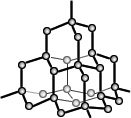 ice and diamond do NOT conduct electricity | 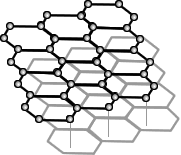 graphite conducts electricity |