induced temporary dipole dipole
(on mouseover)

permanent dipole-dipole

hydrogen-bonding
The temperature at which a substance boils depends on the attractive forces between the particles of the substance in the liquid phase.(on mouseover)
permanent dipole-dipole
hydrogen-bonding
The particles of an organic substance are molecules. Molecules are uncharged groups of atoms joined by covalent bonds.
Although molecules have no overall charge, they may be attracted to one another as a result of
induced temporary dipoles on adjacent molecules
(also known as London dispersion forces, van der Waals forces)
These attractive forces are ALWAYS present in the condensed phase for EVERY molecule.
Their strength depends on the size of the electron cloud of the molecule.
These attractive forces can occur between molecules irrespective of their orientation.
Their strength depends on the size of the electron cloud of the molecule.
These attractive forces can occur between molecules irrespective of their orientation.
permanent dipoles on adjacent molecules
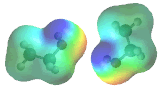
Molecules may have a permanent dipole ONLY if they have polar bonds (bonds between atoms of different electronegativity) as shown for C=O in the butanone molecules shown.
As shown at the right, molecules need to be in the right orientation to be attracted to one another by a permanent dipole-dipole attractive force.
As shown at the right, molecules need to be in the right orientation to be attracted to one another by a permanent dipole-dipole attractive force.
hydrogen-bonding between adjacent molecules.
Possible for HF and in molecules where N-H or O-H bonds are present.
Molecules be attracted to one another by hydrogen-bonding only if they are in the right orientation as shown for the CH3CH2OH molecules.