Line structures are sometimes used
Hydrocarbons in which six carbon atoms are joined in rings are also commonly represented by hexagons, but in this case it is understood that carbons at the corners of the hexagon also have hydrogens. The number of hydrogens is equal to four minus the number of other bonds to carbon (or other groups) at that corner.
 |  |  |  |
| stick structure | line structure | stick structure | line structure |
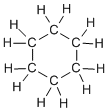
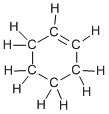
Expanded structures for rings show all atoms and bonds, both to carbon and hydrogen.
The cumbersome nature of these is obvious!
Line structures show bonds between carbon atoms with no atom labels.
These are the quickest to draw but it is important to have an understanding of what the lines represent.
Each corner of the ring in a line structure is a carbon with its hydrogens.
Each carbon at a corner has
two hydrogens if there are two bonds from that carbon to other carbons (see above).
one hydrogen if there are three bonds to that carbon (as in the doubly-bonded carbonabove).
no hydrogens if there are four bonds to that carbon.
There are no examples of this type in the structure above.
one hydrogen if there are three bonds to that carbon (as in the doubly-bonded carbonabove).
no hydrogens if there are four bonds to that carbon.
There are no examples of this type in the structure above.