Alkanes have a great variety of structures. It is important for many aspects of your future study of organic chemistry to recognize that some carbons of an alkane are structurally equivalent due to being in the same bonding environment. The first of these is concerned with isomers.
Carbons in the same bonding environment are bonded to the same atoms or groups of atoms.
For any linear carbon chain, the two methyl groups at the ends of the chain are in equivalent bonding environments.
Pentane example:
The red carbons are each bonded to three hydrogens. They are also each bonded to the four-carbon group CH2CH2CH2CH3.
CH3CH2CH2CH2CH3
Another way of looking at the equivalence of these two carbons is that the chain is symmetrical about the central carbon.
For branched carbon chains, methyl groups bonded to the same carbon are equivalent.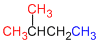
2-methylbutane example:
The red methyl groups are equivalent (they are each bonded to CHCH2CH3). The blue methyl is in a different bonding environment (it is bonded to CH2CH(CH3)2).
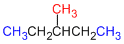 3-methylpentane example:
The blue carbons are in equivalent bonding environments (both bonded to three H and the CH2 of same five-carbon group).
The red carbon is in a different bonding environment (bonded to three H and the CH of the same five-carbon group)
Another way of looking at the equivalence of the methyl groups at the end of the chain is that the chain is symmetrical about the central carbon bonded to CH3.
Carbons in the same bonding environment are bonded to the same atoms or groups of atoms.
For any linear carbon chain, the two methyl groups at the ends of the chain are in equivalent bonding environments.
Pentane example:
The red carbons are each bonded to three hydrogens. They are also each bonded to the four-carbon group CH2CH2CH2CH3.
CH3CH2CH2CH2CH3
Another way of looking at the equivalence of these two carbons is that the chain is symmetrical about the central carbon.
For branched carbon chains, methyl groups bonded to the same carbon are equivalent.
2-methylbutane example:
The red methyl groups are equivalent (they are each bonded to CHCH2CH3). The blue methyl is in a different bonding environment (it is bonded to CH2CH(CH3)2).
The blue carbons are in equivalent bonding environments (both bonded to three H and the CH2 of same five-carbon group).
The red carbon is in a different bonding environment (bonded to three H and the CH of the same five-carbon group)
Another way of looking at the equivalence of the methyl groups at the end of the chain is that the chain is symmetrical about the central carbon bonded to CH3.