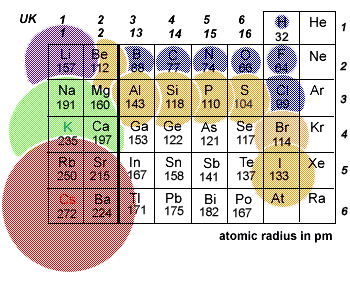
 The size of an atom is a measure of the size of its electron cloud. The graphic shows the experimentally-determined atomic radii for hydrogen and for elements in s- and p-block of the periodic table.
 Atoms in the same column are in the same group in the periodic table.
Atoms in the same row are in the same period in the periodic table.
Atoms in the same row are in the same period in the periodic table.
There are a variety of difficulties associated with measuring the sizes of atoms. It is possible to measure the distance between atoms in the elemental form of metals, but the radii of non-metals are often measured when they are combined with another atom in a covalent bond. The sizes quoted here for non-metals are covalent radii.
It is apparent from both the numbers and the sizes of the circles that atomic radius is a periodic property and thatfor atoms in the same group (column),
for atoms in the same period (row),
the atom nearer the bottom of the group is larger.
for atoms in the same period (row),
the atom closer to the left is larger.
Note that the period numbers are given at the right of each row.It is important to appreciate that using position in the periodic table to compare atom sizes is only valid if the elements are either in the same group or the same period.
For example, all atoms in period 3 are NOT larger than all atoms in period 2 (the only elements in period 3 than are bigger than lithium from period 2 are sodium and magnesium).