In a substitution reaction, the leaving group is displaced from the compound undergoing substitution when it reacts with a nucleophile.
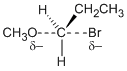
The energy of the transition state depends on the nature of the leaving group. Reaction rates are faster for better leaving groups where the energy of the transition state is lower. As described below, better leaving groups have weaker bonds to carbon and are weaker bases.
Dependence on bond strength:
In the transition state for SN2 reactions the bond to the leaving group is partially broken as shown in the diagram above. Therefore, when comparing different atoms, better leaving groups have weaker bonds to carbon.
The C-X bond strength is lower if X is bigger because the bond is longer.
Dependence on base strength:
In the transition state for SN2 reactions, the charge is more negative at the atom in the leaving group bonded to the carbon undergoing substitution. The transition state energy is lower if the negative charge density at this atom is lower.
When comparing leaving groups where the same atom is bonded to the carbon undergoing substitution (such as HO– and H2O), the better leaving group is the weaker base. This is because weaker bases have lower negative charge density at O.
Thus alcohols undergo substitution reactions only if the OH group is converted to a better leaving group, by, for example, protonation with acid.
The energy of the transition state depends on the nature of the leaving group. Reaction rates are faster for better leaving groups where the energy of the transition state is lower. As described below, better leaving groups have weaker bonds to carbon and are weaker bases.
Dependence on bond strength:
In the transition state for SN2 reactions the bond to the leaving group is partially broken as shown in the diagram above. Therefore, when comparing different atoms, better leaving groups have weaker bonds to carbon.
The C-X bond strength is lower if X is bigger because the bond is longer.
| leaving groups I– > Br– > Cl–> F– relative substitution rate CH3CH2I > CH3CH2Br > CH3CH2Cl > CH3CH2F |
Dependence on base strength:
In the transition state for SN2 reactions, the charge is more negative at the atom in the leaving group bonded to the carbon undergoing substitution. The transition state energy is lower if the negative charge density at this atom is lower.
When comparing leaving groups where the same atom is bonded to the carbon undergoing substitution (such as HO– and H2O), the better leaving group is the weaker base. This is because weaker bases have lower negative charge density at O.
| leaving groups H2O > HO– relative substitution rate CH3CH2OH2+ > CH3CH2OH |
Thus alcohols undergo substitution reactions only if the OH group is converted to a better leaving group, by, for example, protonation with acid.