The solubility of a substance in a particular solvent at a given temperature is the maximum amount that will dissolve in a specified volume of the solvent at that temperature.
Solubility depends on the chemical nature of solute and the solvent.
Pure substances can be broadly classified as ionic, molecular, covalent network or metallic.
The most common solutes are either ionic or molecular substances.
The most common solvents are molecular substances (H2O, CCl4, CH3CH2CH2CH2CH2CH3) that exist as liquids at room temperature.
Solvents can be classified as polar or non-polar.
Water is a polar solvent (H2O).
The charge density map shows that the electron cloud of water has a more negative region and a more positive region.
Hexane (CH3CH2CH2CH2CH2CH3 ) and other hydrocarbon solvents are non-polar.
The electron density map shows no regions of positive and negative charge.
Small alcohols (CH3OH, CH3CH2OH) may also be used as solvents and are of intermediate polarity.
The polarity due to the OH group is diminished by the presence of the hydrocarbon chain.
For solids dissolving in liquid solvents, solubility usually increases with temperature.
Solubility depends on the chemical nature of solute and the solvent.
It is difficult to predict, with certainty, the solubility of a substance in a particular solvent.
However it is possible to make educated guesses based on general guidelines which also give insight into the nature of the dissolving process in terms of the ions, atoms and molecules present in the solute and the solvent.
However it is possible to make educated guesses based on general guidelines which also give insight into the nature of the dissolving process in terms of the ions, atoms and molecules present in the solute and the solvent.
Pure substances can be broadly classified as ionic, molecular, covalent network or metallic.
 Ionic (NaCl) | 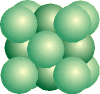 Metallic (Cu) |
 Covalent network (SiO2) |  Molecule (CCl4) |
The most common solvents are molecular substances (H2O, CCl4, CH3CH2CH2CH2CH2CH3) that exist as liquids at room temperature.
Solvents can be classified as polar or non-polar.
 H2O | 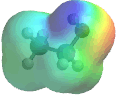 CH3CH2OH |
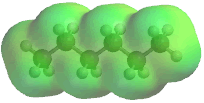 CH3CH2CH2CH2CH2CH3 |
The charge density map shows that the electron cloud of water has a more negative region and a more positive region.
Hexane (CH3CH2CH2CH2CH2CH3 ) and other hydrocarbon solvents are non-polar.
The electron density map shows no regions of positive and negative charge.
Small alcohols (CH3OH, CH3CH2OH) may also be used as solvents and are of intermediate polarity.
The polarity due to the OH group is diminished by the presence of the hydrocarbon chain.