The Grignard reaction was discovered by François Auguste Victor Grignard who received the Nobel prize for his work.
The Grignard reagent is an organometallic compound that arises from the reaction of a compound with a carbon-halogen bond and magnesium metal.
 RBr + Mg
  Rδ– δ+MgBr (done in ether to stabilise the product)
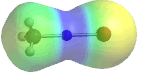
The image of the electron density map for CH3MgBr shows the magnesium is the most positive atom (in blue).
This means the carbon originally bonded to halogen is the more negative atom in the bond to magnesium.
Thus the Grignard reagent can be viewed as a source of H3C:–.
This means that Grignard reagents are basic, reacting with water to form the corresponding alkane and magnesium hydroxide.
H3CMgBr + H2O H3C–H + MgBrOH
In a far more useful reaction of Grignard reagents this electron pair forms a new carbon-carbon bond.
The electron pair that moves in reaction with a carbonyl group is the one associated with the second bond between carbon and oxygen.
The nature of the alcohol produced depends on the nature of the groups bonded to the C=O in the reactant.

The electron pair that moves in reaction with oxirane is the bond between C and O in the strained three-membered ring.
This reaction always results in a primary alcohol that has the general form RCH2CH2OH.
Note that the reaction with oxirane is driven by relief of strain in the ring. Grignard reagents do not react with other ethers.
Indeed ethers such as CH3CH2OCH2CH3 are used as the solvent for the reaction.
The Grignard reagent is an organometallic compound that arises from the reaction of a compound with a carbon-halogen bond and magnesium metal.
RBr + Mg Rδ– δ+MgBr (done in ether to stabilise the product) The image of the electron density map for CH3MgBr shows the magnesium is the most positive atom (in blue).
This means the carbon originally bonded to halogen is the more negative atom in the bond to magnesium.
Thus the Grignard reagent can be viewed as a source of H3C:–.
This means that Grignard reagents are basic, reacting with water to form the corresponding alkane and magnesium hydroxide.
H3CMgBr + H2O
H3C–H + MgBrOHIn a far more useful reaction of Grignard reagents this electron pair forms a new carbon-carbon bond.
Formation of the new bond to a particular carbon is accompanied by corresponding movement of an electron pair from that carbon to a more electronegative atom (usually oxygen). Two examples are shown below. The final product in both cases is an alcohol.
The electron pair that moves in reaction with a carbonyl group is the one associated with the second bond between carbon and oxygen.
The nature of the alcohol produced depends on the nature of the groups bonded to the C=O in the reactant.
The electron pair that moves in reaction with oxirane is the bond between C and O in the strained three-membered ring.
This reaction always results in a primary alcohol that has the general form RCH2CH2OH.
Note that the reaction with oxirane is driven by relief of strain in the ring. Grignard reagents do not react with other ethers.
Indeed ethers such as CH3CH2OCH2CH3 are used as the solvent for the reaction.