The periodic table can be used as a guide to the sequence in which the subshells are occupied by the electrons available on an atom.
The periodic table also indicates how many electrons are available on each atom because the number of electrons is equal to the atomic number of the element.
Consider the electron configuration for O, a p-block element in the second row of the periodic table. Oxygen atoms have eight electrons.
The periodic table also indicates how many electrons are available on each atom because the number of electrons is equal to the atomic number of the element.
Consider the electron configuration for O, a p-block element in the second row of the periodic table. Oxygen atoms have eight electrons.
Because there are more than two electrons, the first shell is fully occupied (1s2)
Because there are more than four electrons, the 2s orbital is fully occupied (2s2)
The four remaining electrons occupy the 2p subshell (2p4). Note that oxygen is the fourth second row element in p-block.
The electron configuration for oxygen is written as 1s2 2s2 2p4
The diagram gives the number of electrons for selected element in the outermost (highest energy) occupied subshell. Note thatBecause there are more than four electrons, the 2s orbital is fully occupied (2s2)
The four remaining electrons occupy the 2p subshell (2p4). Note that oxygen is the fourth second row element in p-block.
The electron configuration for oxygen is written as 1s2 2s2 2p4
the type of highest occupied subshell can be deduced from the block in which the element appears.
the number of electrons in that subshell can be deduced from the position of the element in the block (counting from the left).
any lower energy subshells are completely occupied as seen for oxygen.
the number of electrons in that subshell can be deduced from the position of the element in the block (counting from the left).
any lower energy subshells are completely occupied as seen for oxygen.
For elements in the third row the 1s, 2s and 2p subshells are completely occupied.
For elements in the fourth row the 1s, 2s and 2p, 3s and 3p subshells are completely occupied.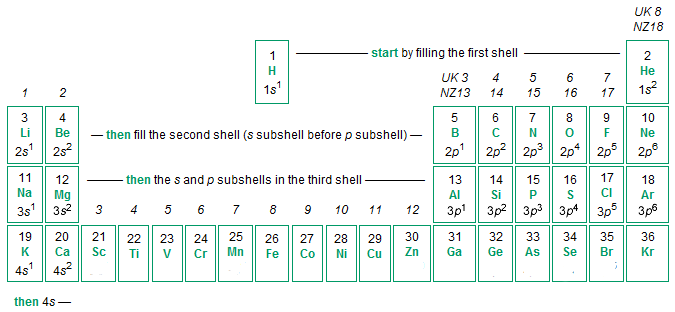
For elements in the fourth row the 1s, 2s and 2p, 3s and 3p subshells are completely occupied.