The bond angle is the angle between adjacent bonds. The diagrams below show that as the number of bonding electron pair domains about the central atom increases, the angle between adjacent bonds decreases. Note that for molecules where all X atoms are the same, the angle between adjacent bonds is also the same.
The bond angles differ from those above if the groups about the central atom are not all the same.
Consider for example the molecules CH4, NH3 and H2O. These all belong to the tetrahedral family, but have different relative numbers of bonding electron-pair domains and nonbonding electron-pair domains.
As the diagrams show, non-bonding electron-pair domains are larger than bonding electron-pair domains. These push the bonding electron-pair domains closer and reduce the bond angles.
Note that only one non-bonding electron-pair domains on O is shown (the other is behind).
| AX2 | AX3 | AX4 |
 |  |  |
| linear | trigonal planar | tetrahedral |
The bond angles differ from those above if the groups about the central atom are not all the same.
Consider for example the molecules CH4, NH3 and H2O. These all belong to the tetrahedral family, but have different relative numbers of bonding electron-pair domains and nonbonding electron-pair domains.
As the diagrams show, non-bonding electron-pair domains are larger than bonding electron-pair domains. These push the bonding electron-pair domains closer and reduce the bond angles.
Note that only one non-bonding electron-pair domains on O is shown (the other is behind).
| three members of the tetrahedral family | CH4 | NH3 | H2O |
| number of non-bonding electron pair domains | 0 | 1 | 2 |
 | 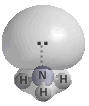 |  | |
| H-E-H bond angle | 109.5° | 107° | 105° |