The Grignard reaction was discovered by François Auguste Victor Grignard who received the Nobel prize for his work. The Grignard reagent is an organometallic compound that arises from reaction of a compound with a carbon-halogen bond and magnesium metal. The magnesium metal is inserted into the carbon-halogen bond.
RBr + Mg Rδ– δ+MgBr
(done in ether to stabilise the product)
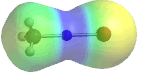
In RMgX the carbon originally bonded to halogen is bonded to a metal and thus is the more negative atom in that bond. Thus a Grignard reagent is a source of a carbon nucleophile. This nucleophile reacts with electrophiles, most notably carbonyl carbon. This carbon-carbon bond-forming reaction is a way of converting smaller carbon compounds into bigger ones.
Thus, as shown below Grignard reagents react with aldehydes and ketones in nucleophilic addition reactions to give alcohols.


When planning a synthesis using a Grignard reagent, it is important to remember that the new bond will be formed to the carbon bearing oxygen and to choose the carbonyl and Grignard component accordingly.
RBr + Mg
Rδ– δ+MgBr(done in ether to stabilise the product)
In RMgX the carbon originally bonded to halogen is bonded to a metal and thus is the more negative atom in that bond. Thus a Grignard reagent is a source of a carbon nucleophile. This nucleophile reacts with electrophiles, most notably carbonyl carbon. This carbon-carbon bond-forming reaction is a way of converting smaller carbon compounds into bigger ones.
Thus, as shown below Grignard reagents react with aldehydes and ketones in nucleophilic addition reactions to give alcohols.
Aldehydes have a hydrogen at the carbonyl carbon. Therefore there is a hydrogen at the carbon bearing oxygen in the product, and the alcohol product arising from aldehydes is secondary. The exception to this is the reaction of methanal (H2C=O) which gives a primary alcohol.


Ketones have no hydrogen at the carbon bearing oxygen, and there is no hydrogen at the carbon bearing oxygen in the product. Thus the alcohol product arising from Grignard reactions of ketones is tertiary.


The red and black colouration for the atoms in the product show which atoms come from the carbonyl compound and which come from the Grignard. Ketones have no hydrogen at the carbon bearing oxygen, and there is no hydrogen at the carbon bearing oxygen in the product. Thus the alcohol product arising from Grignard reactions of ketones is tertiary.
When planning a synthesis using a Grignard reagent, it is important to remember that the new bond will be formed to the carbon bearing oxygen and to choose the carbonyl and Grignard component accordingly.