Acyl chlorides are one example of a class of compounds referred to as carboxylic acid derivatives. Other examples are esters (RCO2R′) and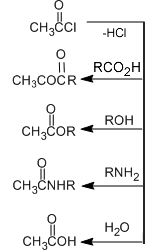 amides (RCONHR) and anhydrides (RCOOCOR).
Acyl chlorides are the most reactive of these compounds and, as shown in the scheme at the right, they are converted rapidly, on reaction with an appropriate nucleophile to an anhydride, ester, amide or carboxylic acid. The overall reaction is a substitution with HCl being a co-product of the reaction.
The pathway for the reaction is initiated by attack of the nucleophile at the carbonyl carbon. This generates a tetrahedral intermediate. After loss of a proton to a second molecule of nucleophile, the carbon-oxygen double bond is re-formed with expulsion of chloride ion.

The reaction is describe as acyl substitution, but as can be seen from the mechanism, it is really an addition followed by an elimination.
amides (RCONHR) and anhydrides (RCOOCOR).Acyl chlorides are the most reactive of these compounds and, as shown in the scheme at the right, they are converted rapidly, on reaction with an appropriate nucleophile to an anhydride, ester, amide or carboxylic acid. The overall reaction is a substitution with HCl being a co-product of the reaction.
The pathway for the reaction is initiated by attack of the nucleophile at the carbonyl carbon. This generates a tetrahedral intermediate. After loss of a proton to a second molecule of nucleophile, the carbon-oxygen double bond is re-formed with expulsion of chloride ion.
The reaction is describe as acyl substitution, but as can be seen from the mechanism, it is really an addition followed by an elimination.