The chlorine oxoanions contain chlorine in positive oxidation states as shown below. These ions can be accessed by reactions that involve auto-oxidation reduction (disproportionation). In disproportionation reactions, an element in an intermediate oxidation state acts as both the oxidant and the reductant.
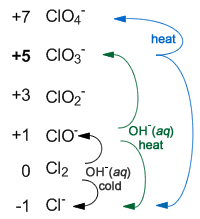
The reaction of elemental chlorine in water to form hypochlorous acid and hydrochloric acid is one example of such a reaction.
Cl2(aq) + 2OH–(aq)
This reaction proceeds to the extent of about 30% in water, but due to the acidity of the products, if the reaction is carried out in alkali, elemental chlorine is completely converted to hypochlorite and chloride as shown in the scheme.
Both hypochlorite ion (ClO–) and chlorate ion (ClO3–) also react by auto-oxidation reduction.
It is important to recognise that atoms in intermediate oxidation states (between the maximum and the minimum for that element) may undergo auto-oxidation-reduction.
The reaction of elemental chlorine in water to form hypochlorous acid and hydrochloric acid is one example of such a reaction.
Cl2(aq) + 2OH–(aq)
ClO–(aq) + H2O(aq) + Cl–(aq)
This reaction proceeds to the extent of about 30% in water, but due to the acidity of the products, if the reaction is carried out in alkali, elemental chlorine is completely converted to hypochlorite and chloride as shown in the scheme.
Both hypochlorite ion (ClO–) and chlorate ion (ClO3–) also react by auto-oxidation reduction.
As the scheme shows, chloride ion is formed in both of these reactions together with an oxoanion containing chlorine in a higher oxidation state than the reactant oxoanion.
It is important to recognise that atoms in intermediate oxidation states (between the maximum and the minimum for that element) may undergo auto-oxidation-reduction.
intermediate oxidation state 
Similar behaviour is seen for the other halogens except for fluorine where the maximum oxidation state is zero.
higher oxidation state + lower oxidation state
Similar behaviour is seen for the other halogens except for fluorine where the maximum oxidation state is zero.