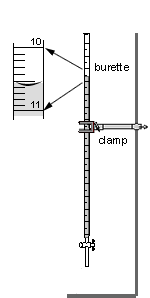
As burettes are graduated in 0.1 lines, your burette reading should have two digits beyond the decimal point. It is standard practice to read the level of the liquid in a burette from the bottom of the dark meniscus and to do so consistently.
The reading taken from the burette shown could be 10.58 . Another operator may interprete the reading as 10.59 . While it may not be possible to estimate to greater than ±0.02 , it is important that the full range between the lines be used.
The reading taken from the burette shown could be 10.58 . Another operator may interprete the reading as 10.59 . While it may not be possible to estimate to greater than ±0.02 , it is important that the full range between the lines be used.
The number of significant figures indicates how the measurement was made, and if a terminal digit is actually zero, it should be recorded as such. Sample readings from the burette and balance are below. Pipette and volumetric flask nominal values are assumed to be known to four significant figures.
| Measurement magnitude | significant digits | |
| balance | 5.006 g | 4 |
| burette | 34.70 | 4 |
| volumetric flask | 250.0 | 4 |
| pipette | 25.00 | 4 |
Notice that the number of significant figures equals the number of digits counted from the first nonzero digit, NOT the number of digits to the right of the decimal point.