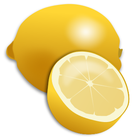
acidic juice
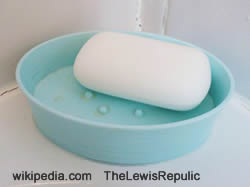
a basic household item
Two important types of compounds are acids and bases. Acidic compounds give lemon juice and vinegar their sour taste. The slippery feel of soapy water is due to the fact that soap is a basic compound.
Acids and bases react with one another to give rise to substances that are less acidic and basic. This reaction is therefore referred to as a neutralisation.
How can I recognize which compounds are acids and which compounds are bases?
Acids are hydrogen-containing compounds that can donate H+.
HCl is an acidic substance that can donate one H+ to a base. Cl– is also formed in the reaction.
HCl is a gas and dissolves in water to give a solution known as hydrochloric acid.
H2SO4 (sulfuric acid) is an acidic substance that can donate two H+ to a base. SO42– (sulfate anion) is also formed in the reaction.
There are lots of hydrogen-containing compounds.
Usually you can pick out an acid because it is common practice to put the H first when writing the formula of an acidic hydrogen-containing compound.
HCl is a gas and dissolves in water to give a solution known as hydrochloric acid.
H2SO4 (sulfuric acid) is an acidic substance that can donate two H+ to a base. SO42– (sulfate anion) is also formed in the reaction.
There are lots of hydrogen-containing compounds.
Usually you can pick out an acid because it is common practice to put the H first when writing the formula of an acidic hydrogen-containing compound.
Bases are compounds that can accept H+.
Ionic solids that are bases have a metal cation and a basic anion.
OH– (hydroxide ion) is a basic anion that accepts H+ to give H2O.
O2– (oxide ion) is a basic anion that accepts 2H+ to give H2O.
OH– (hydroxide ion) is a basic anion that accepts H+ to give H2O.
O2– (oxide ion) is a basic anion that accepts 2H+ to give H2O.