 Acidic substances dissolve in water to give an acidic solution due to a higher concentration of H3O+ in their solution than in water.
Basic substances dissolve in water to give a basic (or alkaline) solution due to a higher concentration of OH– in their solution than in water.
pH depends on the relative concentrations of H3O+ and OH– ions in the solution.
A solution of pH 1 is more acidic than a solution of pH 5.
This is due to a higher H3O+ concentration (and lower OH– concentration).
A solution of pH 11 is more basic than a solution of pH 9.
This is due to a higher OH– concentration (and lower H3O+ concentration).
This is due to a higher H3O+ concentration (and lower OH– concentration).
A solution of pH 11 is more basic than a solution of pH 9.
This is due to a higher OH– concentration (and lower H3O+ concentration).
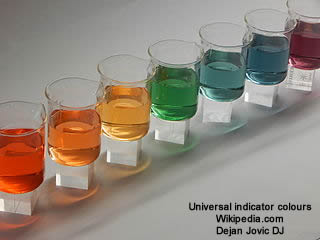
Universal indicator is a mixture of dyes that can be used to show the pH of the solution.
A small portion of the dye may be added to the solution.
Alternately strips of paper impregnated with the dye(s) (pH paper) may be dipped into the solution.
Alternately strips of paper impregnated with the dye(s) (pH paper) may be dipped into the solution.
The diagram shows the range of colours available from universal indicator as well as the colour changes observed for pH paper.
For acidic solutions, the colour ranges from red to yellow.
For basic solutions, the colour ranges from green to purple.
For solutions that are neither acidic or basic, the colour is green.
For basic solutions, the colour ranges from green to purple.
For solutions that are neither acidic or basic, the colour is green.
 | |||||||
| pH | |||||||
| universal indicator | |||||||
| pH paper dry pH paper wet | |||||||
| concentration | H3O+ | H3O+ | H3O+ | H3O+ | H3O+ | ||
| concentration | OH– | OH– | OH– | OH– | OH– | ||