Solids have a specified shape because of the attractive forces between the structural units of which they are comprised. Examples of different types of solids, the various structural units and the attractive forces between them are shown below.
Temporary dipole attractive forces are stronger if the electron clouds are larger so that the interaction can occur over a larger surface area.
Roll your mouse over the image below to see how temporary dipoles are created when the electron clouds of molecules approach one another.

| Network solid (giant structure) Covalent bonds between carbon atoms in diamond |  | strong attractive force high melting points | no charged particles can move no conductivity |
| Ionic solid Ionic bonds between cations and anions |  | strong attractive force high melting point | ions can move if solid melted conducting as a melt |
| Molecular solid Temporary dipoles (also known as van der Waals forces or London dispersion forces) between I2 molecules See image below. |  | weak attractive force low melting | no charged particles can move no conductivity |
| Metallic solid Metallic bonds between cations and a sea of electrons | 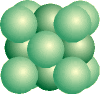 | variable attractive force range of melting points | electrons can move in solid or liquid good conductivity |
Temporary dipole attractive forces are stronger if the electron clouds are larger so that the interaction can occur over a larger surface area.
Roll your mouse over the image below to see how temporary dipoles are created when the electron clouds of molecules approach one another.